
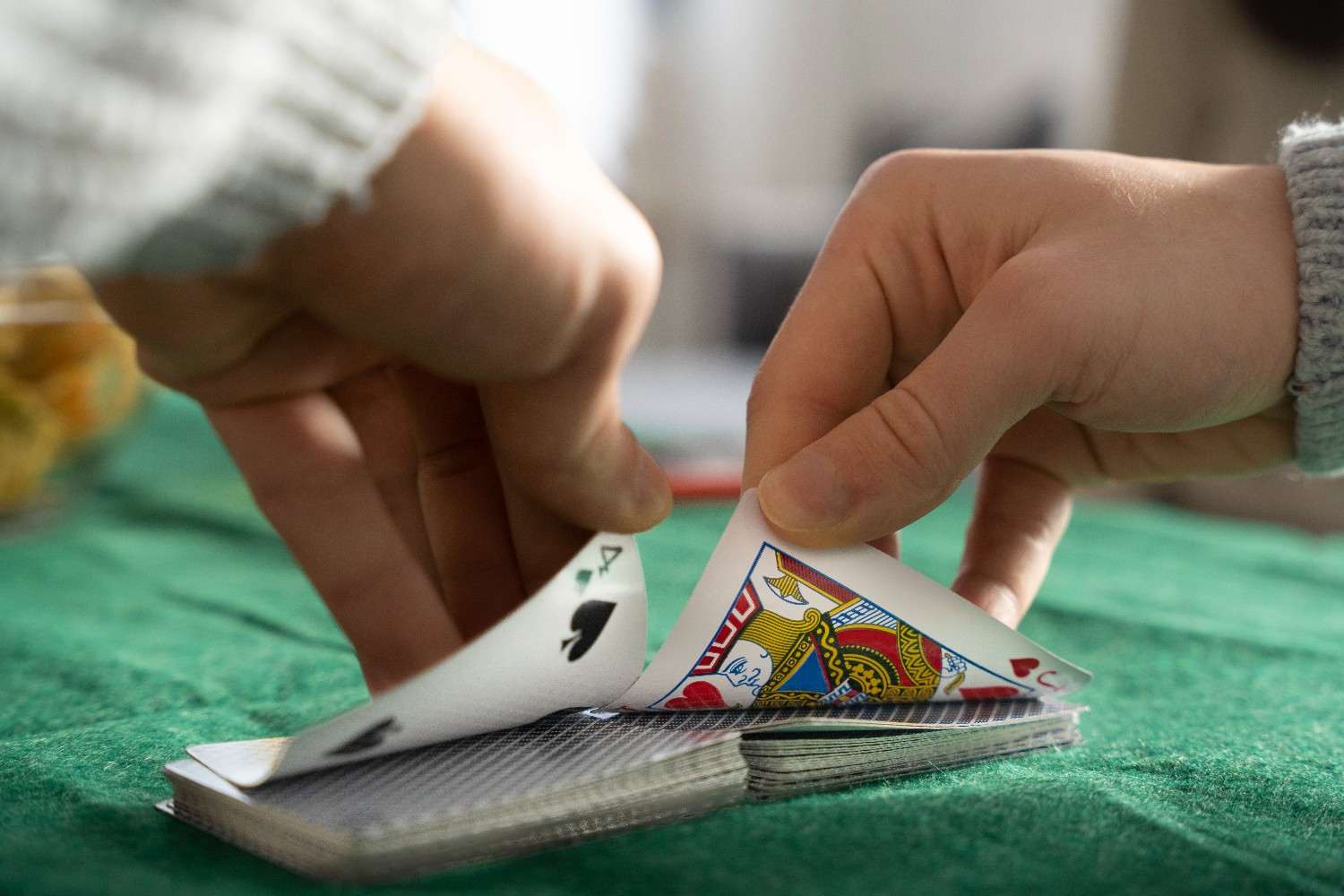
Card Counting Dragon Tiger Mein Possible Hai? 52-Card Deck Ki
Suppose kuch rounds ke baad aapne cards notice kiye:
K, Q, K, 10, 3, 8, A, Q…
Ab thought aata hai:
“Agar mujhe pata hai kaunse cards already nikal chuke hain, toh kya main remaining deck ka maths calculate kar sakta hoon?”
This is a much better-defined mathematical question than:
“Last 5 baar Dragon aaya hai, ab Tiger due hai?”
Because a Dragon/Tiger history board usually tells us only who won.
Actual exposed cards can tell us something different:
which ranks are no longer available in the same finite deck or shoe.
If cards are genuinely being dealt without replacement from a continuing finite shoe, removing particular cards changes the composition of what remains.
So yes, card-removal information can mathematically change conditional probabilities.
But that doesn’t automatically mean a practical “card counting system” predicts the next Dragon or Tiger result. The distinction is important.
Fresh 52-Card Deck Se Start Karte Hain
Use our simplified single-deck model:
- 52 standard cards
- 13 ranks
- 4 cards per rank
- Ace treated as low
- King treated as high
- One card to Dragon
- One card to Tiger
- Higher rank wins
- Same rank = Tie
Before any cards have been removed, the model is symmetric.
Total ordered two-card deals:
52 × 51 = 2,652.
Tie combinations:
52 × 3 = 156.
Therefore:
P(Tie) = 156/2652 = 1/17 ≈ 5.88%
and by symmetry:
P(Dragon) = 8/17 ≈ 47.06%
P(Tiger) = 8/17 ≈ 47.06%.
That’s our starting position.
Now let’s start removing known cards.
Ek King Remove Hua — Kya Probability Change Hoti Hai?
Suppose an earlier exposed card was:
K♠
and that card remains out of the deck.
Now the deck contains:
51 cards.
Instead of four Kings, only:
3 Kings
remain.
Every other rank still has four cards.
Has something changed?
Yes.
The remaining deck is no longer perfectly rank-balanced.
King is slightly underrepresented.
For example, before removal:
P(next card is King) = 4/52 ≈ 7.69%.
After one King is removed:
P(next card is King) = 3/51 ≈ 5.88%.
That’s a real mathematical change.
It comes from card composition, not from a streak or visual pattern.
Removing a King Doesn’t Automatically Mean “Tiger Next”
This is where card counting can easily be misunderstood.
If a King has been removed, we can accurately say:
“There are fewer Kings left in the deck.”
But jumping from that fact to:
“Therefore Tiger is more likely next.”
requires another calculation.
Why?
Because Dragon and Tiger are still receiving cards from the same remaining deck.
Neither side owns the remaining Kings.
A remaining King could go to Dragon.
Or it could go to Tiger.
Simply removing a high card from a symmetric deck does not automatically favour one labelled side over the other before either current card is dealt.
This is a powerful symmetry point.
If the current round deals two random cards from the same remaining shoe and the labels are otherwise symmetric, then for every unequal ordered pair:
Dragon gets higher card / Tiger gets lower card
there is a reversed ordering:
Dragon gets lower card / Tiger gets higher card.
So composition can change things such as the probability of a Tie and the distribution of ranks without necessarily creating an unconditional Dragon-vs-Tiger side advantage.
Then What Exactly Can Card Removal Change?
Suppose several cards have already been removed.
Example:
K♠, K♥, Q♦, J♣, 10♠, 3♥
Now only:
46 cards
remain.
The rank composition is no longer uniform:
| Rank | Original Copies | Removed | Remaining |
|---|---|---|---|
| King | 4 | 2 | 2 |
| Queen | 4 | 1 | 3 |
| Jack | 4 | 1 | 3 |
| 10 | 4 | 1 | 3 |
| 3 | 4 | 1 | 3 |
| Other ranks | 4 each | 0 | 4 each |
Now questions such as:
“How likely is the next card to be King?”
or:
“How many cards can beat a known Queen?”
must use this updated composition.
The original fresh-deck formulas cannot simply be copied over.
Known Current Card + Removed Cards Is Where Composition Really Matters
Consider a more specific example.
Suppose Dragon’s current card is:
Queen.
In a fresh single deck, Tiger can beat Queen with any King.
Normally:
4 Kings
would be available among the 51 cards remaining after Dragon receives its Queen.
So:
P(Tiger wins | Dragon Queen) = 4/51 ≈ 7.84%.
But imagine we’re continuing through a finite shoe and three Kings had already been removed before this round.
Only:
1 King
remains.
Suppose 10 cards in total had been removed before Dragon’s Queen was dealt.
After Dragon receives its Queen, there would be:
41 unknown cards remaining.
If that one remaining King is the only rank capable of beating Queen, then:
P(Tiger beats Queen) = 1/41 ≈ 2.44%.
Compare:
Fresh deck: 4/51 ≈ 7.84%
Illustrative depleted deck: 1/41 ≈ 2.44%
That’s a meaningful conditional probability change.
But notice what caused it:
knowledge of exact card removals.
Not:
“Dragon won the previous three rounds.”
Why D/T History Is Much Weaker Than Actual Card History
Suppose the result history is:
D → D → T → D → T.
What cards were involved?
We don’t know.
The first Dragon win could have been:
K vs 2.
Or:
8 vs 7.
Or:
5 vs 3.
All produce exactly the same history-board symbol:
D.
But they remove very different cards from a continuing shoe.
For example:
K vs 2
removes one extremely high and one low rank.
8 vs 7
removes two middle ranks.
The result label alone loses most of that composition information.
So if someone says:
“Main last 20 D/T results dekh ke card count kar raha hoon,”
that’s not the same thing as tracking the actual ranks that have left a finite shoe.
Can We Calculate Tie Probability From a Depleted Deck?
Yes, and this demonstrates the idea nicely.
Suppose a remaining shoe contains N cards.
Let the number of remaining cards of each rank be:
n1, n2, … n13.
To create a Tie, both dealt cards must come from the same rank.
The number of unordered same-rank pairs is:
Σ C(nr, 2).
Total unordered two-card pairs are:
C(N, 2).
Therefore:
P(Tie) = [Σ C(nr, 2)] / C(N, 2).
For a fresh 52-card deck, every rank has:
nr = 4.
So:
13 × C(4,2) = 13 × 6 = 78
same-rank pairs.
Total pairs:
C(52,2) = 1,326.
Therefore:
78/1326 = 1/17 ≈ 5.88%.
If the rank counts become uneven after cards are removed, this Tie probability can change.
So Is Dragon Tiger Card Counting “Possible”?
The answer depends on what we mean by card counting.
If we mean:
“Can known removed cards be used to calculate updated probabilities in a finite deck?”
Mathematically, yes.
That’s ordinary conditional probability.
If we mean:
“Can a simple running number automatically tell us Dragon or Tiger will win next?”
That does not follow.
There are several separate issues:
1. Is the game actually using a continuing finite shoe?
If the cards are reset or independently generated between rounds, previous physical-card removals may not carry forward.
2. Are all removed cards observable?
Incomplete information produces an incomplete deck state.
3. How many decks are involved?
A single removed card has a much larger compositional effect in one deck than in a large multi-deck shoe.
4. When is the shoe reshuffled?
Once a reshuffle occurs, previous removal information may no longer describe the new shoe.
5. What exactly is being predicted?
Rank distribution, Tie probability and Dragon-vs-Tiger winner are different statistical questions.
So “card counting works” is too vague to be mathematically useful.
Frequently Asked Questions
Can cards be counted in Dragon Tiger?
If cards are dealt without replacement from a continuing finite shoe and removed cards are known, their removal can be tracked mathematically. Whether that information is available or relevant depends on the actual game mechanism.
Does removing a King make Tiger more likely to win the next round?
Not automatically. Before either current card is dealt, both Dragon and Tiger draw from the same remaining composition. Removing a King changes the deck but does not by itself assign the remaining high cards to Tiger.
Can removed cards change Tie probability?
Yes. Tie probability depends on how many same-rank pairs remain in the shoe. Uneven rank depletion can therefore change it.
Is D-D-T-D-T enough information for card counting?
No. Those symbols reveal winners but not necessarily the exact card ranks that were removed. Many different card combinations can produce the same D/T history.
Why are exact card ranks more informative than result history?
Exact ranks tell us which cards have left a finite shoe. This directly changes the composition of the remaining cards, whereas a winner label discards much of that information.
Does card counting guarantee the next Dragon Tiger result?
No. Updated probabilities still describe uncertainty. Knowing the remaining composition does not tell you which particular cards will be dealt next.
What happens after a reshuffle?
If a complete fresh shoe is created, the previous shoe’s card-removal information no longer describes the current composition.
Does card counting work the same with multiple decks?
No. The same principle applies, but there are more copies of every rank. Individual card removals generally have a smaller proportional effect when many decks remain in the shoe.
Final Takeaway
There’s a major difference between:
“Dragon 4 baar aa gaya.”
and:
“Two Kings and three Queens have already been removed from this finite shoe.”
The first is primarily result history.
The second is card-composition information.
If cards continue to be dealt without replacement, exact removals can genuinely change mathematical probabilities because the remaining deck is different.
For example, if Dragon shows Queen in a fresh single deck, normally:
4 Kings
can beat it.
If three Kings are already known to be gone, only:
1 King
may remain capable of beating that Queen.
That’s a real conditional probability change.
But it still doesn’t mean:
“next result confirm hai.”
Card counting, in the mathematical sense, updates the probability distribution based on known composition.
It doesn’t remove randomness from which cards are dealt next.
And if a particular Dragon Tiger implementation resets cards, uses a different shoe structure or doesn’t expose enough information, the same analysis may not apply at all.
So the scientifically useful question isn’t simply:
“Dragon Tiger mein card counting hoti hai?”
It’s:
“Does the actual mechanism preserve known card removals across rounds, and if it does, how does the remaining composition change the probability we’re trying to measure?”
Editorial Note: This article is for probability and statistical education. Examples use simplified standard-card models to explain finite-deck conditional probability. Actual Dragon Tiger implementations can differ in deck count, shoe depth, reshuffling, card visibility, dealing procedure and rules. The article does not provide a wagering system or guarantee that card tracking can predict future results.